

Why your head feels full or foggy at work
 22 Oct 2026 • 6min
You’re rereading the same email for the third time and it still hasn’t gone in. Or maybe your mind is racing between six half-finished jobs while a seventh pings into your inbox. Either way, thinking feels much harder than it should.
Brain fog at work and that crowded, overloaded feeling are really common. A lot of it comes down to how the brain handles load and recovery, and there’s plenty you can do about it.
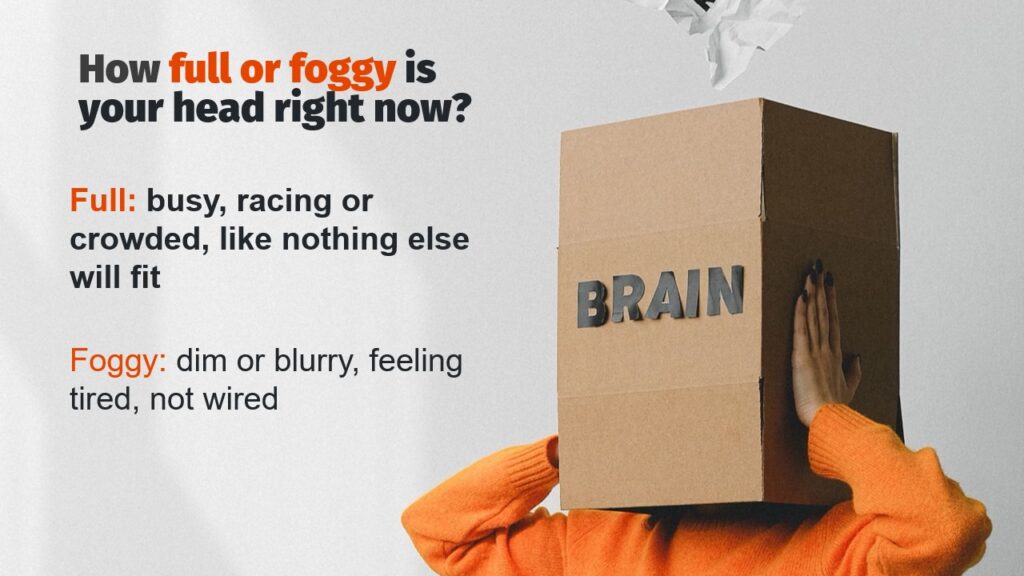
Full head or foggy head?
A full head feels busy and crowded, like nothing else will fit. You’re jumping between tasks or lying awake running through your to-do list. It usually comes from having a lot on, and it’s helped most by getting things out of your head and switching off after work.
A foggy head feels slow and flat, a bit like driving through fog. Words sit on the tip of your tongue and getting started is a struggle. It tends to happen when you’re low on charge from short sleep or too little recovery. Researchers describe mental fatigue as a state where effort starts to feel more costly and attention gets harder to direct (Boksem & Tops, 2008). Sleep, movement, breaks and matching tasks to your energy usually help most here.
The two often feed each other. Research has linked work-related rumination with poorer sleep and more fatigue (Querstret & Cropley, 2012), and mentally stepping away from work is one of the main ways we recover (Sonnentag & Fritz, 2007). So a full head at night can lead to a foggy one the next day, and the slower work that follows fills it right back up.
Your brain has a small desk
Working memory holds information while you use it. Picture it as a small desk where you do the actual work, with long-term memory as the filing cabinet nearby. Cowan (2001) concluded that, on average, we can hold only around four chunks of information in mind at once.
Every unanswered message and worry takes up a bit of that desk. That’s what mental load and cognitive overload feel like from the inside.
Stress adds to it. When the amygdala, the brain’s alarm system, goes off, the prefrontal cortex (which handles planning, problem-solving, decision-making, and attention) doesn’t work as well. Arnsten (2009) describes the prefrontal cortex as the brain region most sensitive to stress. Illness, medications, dehydration and skipped breaks can affect your cognitive capacity on a given day too.
Why multitasking leaves you scattered
The brain can’t really do two thinking tasks at once, so when we multitask, it switches rapidly between them. Each switch costs time, and the cost is higher for complex or unfamiliar tasks (Rubinstein et al., 2001).
There’s a hangover effect as well. Leroy (2009) called it attention residue: after you switch, part of your attention stays on the last task. Jumping out of a report to “quickly” answer a message often means coming back with less than full focus.
Getting things off your mind
With a full head, it helps to take things out of it. Using a list, a calendar or a reminder to lighten the load on your memory is called cognitive offloading (Risko & Gilbert, 2016).
In the workshop’s “Close your tabs” activity, you write down the three things taking up the most space in your head. For each one, you decide whether to close it, bookmark it by parking it with a next step, or leave it open for now.
That next step matters. Masicampo and Baumeister (2011) found that unfinished goals led to intrusive thoughts during an unrelated task, and making a specific plan for them reduced those thoughts even though the goal wasn’t done yet. A good plan names the next action plus a day and time. Our tip is to make that step small enough to do in under 15 minutes.
You can also design the last five minutes of your workday as a shutdown ritual, noting what’s first tomorrow. In a sleep lab study, people who spent five minutes writing a to-do list before bed fell asleep faster than people who wrote about tasks they’d already finished (Scullin et al., 2018). It was a small study of young adults, but it’s an encouraging sign that putting loose ends on paper helps.
Recharging when you’re running low
When your head is foggy, sleep is the big one. An Australian study found that after 17 to 19 hours awake, performance on some tests was as poor as, or worse than, at a blood alcohol concentration of 0.05 (Williamson & Feyer, 2000).
Movement helps too. A meta-analysis found a single bout of exercise can give a small, short-term lift to thinking and attention (Chang et al., 2012).
Short breaks are worth protecting. A review of micro-breaks (up to 10 minutes) found they helped people feel more energised and less fatigued, although effects on performance were smaller and mostly showed up on less demanding tasks (Albulescu et al., 2022).
Try building a recovery menu of things that genuinely refresh you, with a two-minute option like a stretch, a ten-minute option like a walk, and something after work that helps you switch off. Our Improving Energy workshop goes deeper on this.
What this means for teams
For HR, people and culture teams and leaders, much of this is practical. Clear priorities, fewer interruptions and leaders who model a real end to the day all help. Where stress or exhaustion is high, our Managing Stress and Managing Burnout workshops can sit alongside this.
If you have ongoing concerns about your memory or concentration, please have a chat with your GP.
Frequently asked questions
What causes brain fog at work?
Brain fog at work is often linked to mental fatigue, short sleep and not enough recovery. Stress, illness, dehydration and some medications can also affect how clearly you think.
Why does my head feel full at work?
A full head usually means your working memory is overloaded. It can only hold a few things at once, so unfinished tasks and worries crowd it quickly. Writing things down and giving each loose end a clear next step can help free up space.
Does multitasking affect focus at work?
Research suggests it does. The brain switches between thinking tasks rather than doing them at once, and each switch costs time and leaves some attention on the last task. Grouping similar work and protecting focus time can help.
Bring Improving Cognitive Capacity to your team
Our new Improving Cognitive Capacity workshop is designed to help people understand why their head can feel full, foggy or stretched thin, and what’s going on in the brain when it does. Through interactive activities and practical, research-backed tools, participants learn how to protect their focus, clear their mental load and recharge so they can think more clearly at work.
It runs as a 1 or 2 hour session, online or in person anywhere in Australia, tailored to your organisation and built on the research in this post. If your people could do with more headspace, have a look at the Improving Cognitive Capacity workshop and get in touch. We’d love to hear from you.
Want to Read More?
Workplace
Why your head feels full or foggy at work
You’re rereading the same email for the third time and it still hasn’t gone in. Or maybe your mind is racing between six half-finished jobs while a seventh pings into your inbox. Either way,…
22 Oct 2026 6min read
 Workplace
Are Australian workplaces ready to support someone who is struggling?
October is both Mental Health Month and National Safe Work Month in Australia, and to mark the start of it our CEO, Dr Joep van Agteren, recorded a short video with a fairly sobering…
08 Oct 2026 3 min read
 Workplace
What is Protect, Promote, Respond?
What is Protect, Promote, Respond? If you’ve been working on mental health in your workplace lately, there’s a good chance you’ve come across the phrase Protect, Promote, Respond. It’s a way of describing the…
08 Oct 2026 6 minute read