

Fix the work, not the worker?
 17 Nov 2026
Why workplaces need support at every level
There are two popular ideas in workplace mental health, “fix the work, not the worker” and “individual-level programs don’t work”. Both of these come from a good place, but both leave out the part where most people who struggle at work actually sit.
The first (fix the work, not the worker) is a cry for organisations to take responsibility for the conditions that harm people, such as workload, bullying and job insecurity, and the second (individual level programs don’t work) often follows from it: if the work is the problem, support aimed at individuals becomes a distraction.
It’s true that organisations should own the conditions that harm people, and that no workshop can make up for a harmful workplace. But we don’t agree that work is the main cause of most people’s struggles, or that support for individuals should be dismissed.
In this post we look at why fixing workplace conditions can only get us so far, what the evidence on individual-level programs does and doesn’t show, and why we think workplaces need support at several levels at once.
What the workplace does explain
Work can damage mental health, and employers can do a lot about it. The idea is often illustrated with a fish in a fishbowl: you can treat a sick fish as much as you like, but if it goes back into a dirty bowl it will keep getting sick.
Australia has been a frontrunner in treating psychosocial hazards, meaning the parts of work and workplace relationships that can cause psychological harm, as something employers must monitor and control. That has pushed many organisations to look past tick-box wellbeing initiatives and towards how work is actually structured, which we think is a good thing.
The research suggests the effect is real and sizeable:
- Job strain, a mix of high demands and low control, is estimated to account for about 13% of depression in working men and 17% in working women, in a sample of working Victorians (LaMontagne et al., 2008).
- Across 35 European countries, five work pressures combined (job strain, effort-reward imbalance, job insecurity, long hours and bullying) are estimated to account for about 26% of depression, with a 95% confidence interval of 16% to 35% (Niedhammer et al., 2024).
Those are not small numbers. This is a share of mental ill-health that employers directly control, and the authors of the Australian study describe job strain-related depression as substantial and preventable.
The blind spot: most distress starts outside work
The same numbers have a flip side. If workplace pressures account for somewhere between about 13% and 26% of depression, then most of it comes from somewhere else: personal finances, whether someone has social support, and difficult home situations such as domestic violence are all large predictors of poor mental health, and there is a substantial genetic and biological component as well. Some diagnoses develop and play out whatever the workplace or home conditions look like.
The workplace signal also gets weaker beyond depression. Joep’s article on this points to research finding that anxiety has a less robust link to work, and that in one study the link between job strain and clinical depression nearly disappeared once a worker’s prior mental health was taken into account.
Back to the fishbowl: you can clean the work bowl as thoroughly as you like, but if someone goes home to a hard situation, or lives with a condition that is largely biological, a spotless bowl won’t be enough, and often it won’t change their symptoms at all. That doesn’t make better workplaces less important. It means they can’t be the whole answer, and that the many people who walk through the door each day struggling for reasons that have little to do with work still deserve support.
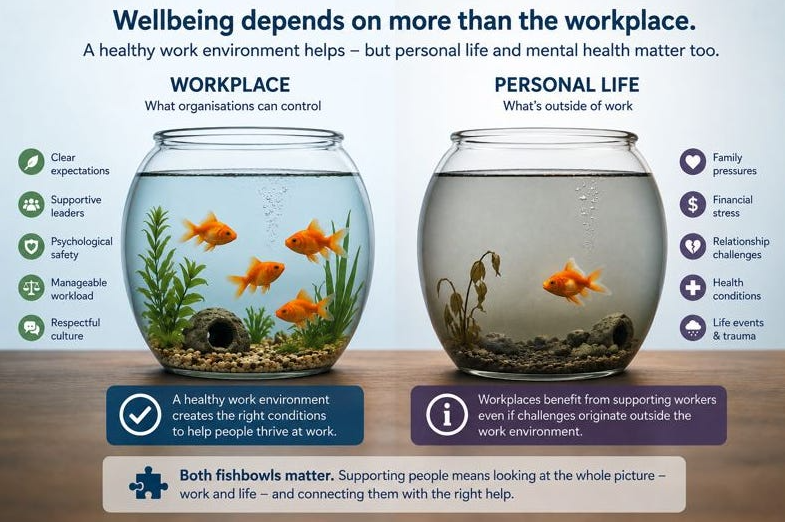
Image via: https://substack.com/@joepvanagteren
Do individual-level programs work?
The study that’s had a lot of attention as of late is Oxford researcher William Fleming’s 2024 paper in the Industrial Relations Journal. It used survey data from 46,336 workers in 233 UK organisations to compare people who took part in common programs, such as resilience training, mindfulness and wellbeing apps, with people who didn’t, and found that participants appeared no better off across several wellbeing measures. It is a large and useful study, and its main message, that organisations have to change the workplace and not just the worker, is one we support.
The design does have limits that matter for the conclusion. It is cross-sectional, which means it compares different people at one point in time rather than tracking the same people before and after a program. The Oxford team also thinks the small negative differences for some programs reflect selection effects, because people with lower wellbeing are more likely to sign up, and the paper’s own abstract notes that the existing evidence on these programs is generally positive. Concluding that no reliable benefit exists is a big call to make from this design alone.
Implementation quality is the other piece, and real-world studies rarely account for it. It’s important to acknowledge that the paper itself does address this in it’s discussion notes. It states that surveys across many organisations include programs delivered at very different levels of quality, that trials run in one or a few settings with strong design can show benefits that shrink in everyday organisational life, and that these programs should perhaps only be offered where high-quality delivery is achievable. Unfortunately, the prose at the back-end of a paper doesn’t get the headlines, so people have run with the messaging that individual-level programs don’t work.
In practice, programs can differ a lot in at least three ways:
- A well-delivered program versus something done slap-dash
- Participation that is opt-in versus forced
- A two-hour session on one day versus work built up over a longer period
That is why “it doesn’t work” can sometimes really mean “it wasn’t done well”.
Is organisational action more effective?
A lot of the case for putting organisational change first rests on the hierarchy of controls. The framework comes from physical safety, where it ranks ways of managing a risk by how well they work: removing the hazard sits at the top, and measures that rely on individuals, such as training or protective equipment, sit near the bottom. Applied to mental health, that logic says changing the work should always beat supporting the person. It is an intuitive framework, and we use it ourselves to explain different types of controls, but we don’t think it works as a strict ranking for psychological health.
There are two problems with it. The first is that the hierarchy was built for physical hazards and has been stretched to cover something far messier. Researchers such as Kjærgaard and colleagues have adapted it for psychological risks, but controls still don’t fall neatly into separate tiers. The second is that the evidence for the ranking is thinner than the framework suggests. Much of the support for the higher tiers comes from studies showing that the lower tiers don’t work, which is how Fleming’s study tends to get used, and as we saw above, that depends heavily on how those programs were delivered and evaluated. Even in the adapted version, the effectiveness of the higher tiers is described as “anticipated” rather than demonstrated.
It is reasonable to expect organisational changes to be more reliable, because they depend less on how individual people respond. But reliable is not the same as effective, and the idea that organisational approaches beat individual-level support has not yet been established, whether for workplace hazards or for the many other reasons people struggle at work. Joep compares it to Maslow’s pyramid: a tidy picture with intuitive logic and real gaps in the evidence. The pyramid wasn’t drawn by Maslow, and he said the order of needs isn’t fixed. A ranking can be a helpful way to think, but treating it as settled makes it easy to dismiss support that people need.
What this means if you lead people
Instead of picking favourites, it helps to think in layers. Individual, interpersonal, organisational and community-level support all matter, because struggle comes from both personal and professional sources and psychological health is messy. A useful way framework to use that we recommend is Protect, Respond and Promote: protect people from risks at work, respond when someone is struggling, and promote the conditions for wellbeing. Safety professionals, wellbeing professionals and mental health professionals each hold a piece of that picture, and none of them needs to claim superiority.
Regulation gives employers a legal reason to support their people’s mental health, and that matters. But there is also a practical reason, whatever the cause of the problem: Your people will likely have periods where they struggle, where they won’t be at their best, and replacing them often costs more than supporting them through a rough patch.
Many people also don’t tell their workplace when they are struggling, so your high performer may have been managing anxiety for years without you knowing, and could still benefit from support.
Guidance on supporting people with mental ill-health at work is thin at the moment. Wellbeing professionals tend to focus on making work engaging and meaningful, while psychosocial risk professionals focus on restructuring conditions, which leaves a hole in the middle where people rely on ad hoc support and on leaders who happen to understand the need for flexible work and return-to-work arrangements. Awareness days like R U OK?, training that builds staff and leader capability, and employee assistance programs are often dismissed as too individual-focused, but given everything above, they are vital.
Before you run or buy a workshop/program, it is worth asking:
- Who is it for, and how do they take part: by choice or because they were told to?
- How is it spread over time: one session, or practice built up over weeks?
- Who is delivering it, and how will you know it is being delivered as designed?
- What is changing in the work itself, such as workload, how change is handled and how managers support their teams?
- How will you know whether it helped, and who will look?
Where we land
“Fix the work, not the worker” is right that organisations own the conditions they create, but it goes too far if it suggests a worker’s struggles start and end there.
We are not interested in arguing about which level of support wins, because that tends to leave everyone talking past each other. We would rather improve how workplaces support people who are struggling, whatever the cause, so that they and their organisations can flourish. That means fixing the work where the work is the problem and still supporting the person where it isn’t, asking hard questions about any program, measuring what happens, and being willing to stop what isn’t helping.
If you lead people and want more conversations like this, come along to the next Happy Hour, our live monthly session on Substack where Joep and Matt talk about all things wellbeing. [add Happy Hour link] For the longer version of this argument, read Joep’s article on Substack. [add article link]
Sources
- Joep van Agteren, “Most mental health problems at work are not caused by the workplace”, Substack, 25 June 2026
- LaMontagne et al. (2008). Job strain: attributable depression in a sample of working Australians. BMC Public Health
- Niedhammer et al. (2024). The overall fractions of coronary heart diseases and depression attributable to multiple dependent psychosocial work factors in Europe. International Archives of Occupational and Environmental Health
- Fleming (2024). Employee well-being outcomes from individual-level mental health interventions: cross-sectional evidence from the United Kingdom. Industrial Relations Journal
- Wellbeing Research Centre, University of Oxford: “More ambition” needed to improve workplace wellbeing (10 January 2024)
- Joep van Agteren and Matt Iasiello on Happy Hour (Substack live), and the Be Well Co LinkedIn post and comments that followed
- Studies by Madsen et al. (2017), Kjærgaard and colleagues, Wang et al. (2014) and Wieclaw et al. (2008) are referenced in Joep’s article
Want to Read More?
Wellbeing, Workplace
Fix the work, not the worker?
Why workplaces need support at every level There are two popular ideas in workplace mental health, “fix the work, not the worker” and “individual-level programs don’t work”. Both of these come from a good…
17 Nov 2026
 Workplace
Every leader can be taught to provide mental health support at work
By Joep van Agteren, PhD, Be Well Co | Written for Wellbeing Explained Substack | October 2026 Short answer: Leaders don’t need to be counsellors to support a team member who is struggling. They…
09 Nov 2026 4 min read
 Workplace
Why your head feels full or foggy at work
You’re rereading the same email for the third time and it still hasn’t gone in. Or maybe your mind is racing between six half-finished jobs while a seventh pings into your inbox. Either way,…
22 Oct 2026 6min read