

What is Protect, Promote, Respond?
 08 Oct 2026 • 6 minute
What is Protect, Promote, Respond?
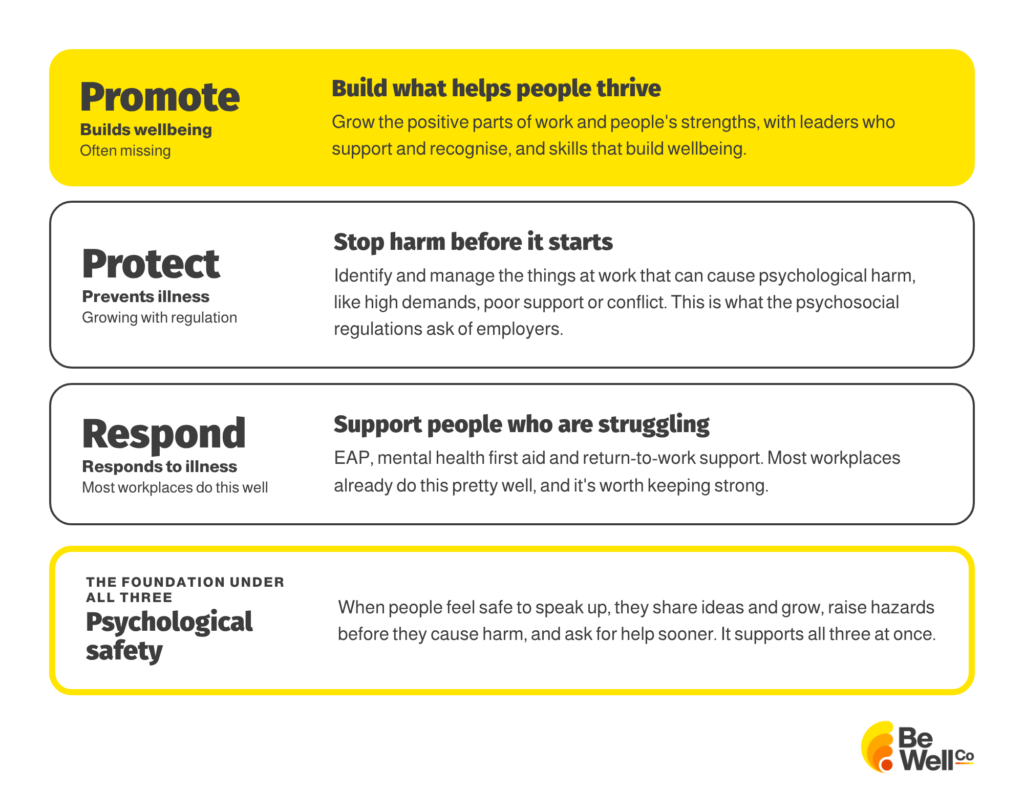
If you’ve been working on mental health in your workplace lately, there’s a good chance you’ve come across the phrase Protect, Promote, Respond. It’s a way of describing the three areas an organisation needs to cover to look after the mental health of its people. Protect is about preventing harm caused by work, Promote is about building wellbeing, and Respond is about supporting people who are already struggling.
It sounds simple, and in a lot of ways it is. But most workplaces we work with are much stronger in one or two of these areas than the third, and the one that usually gets left behind is Promote.
Hear it from someone who helped build it
Our Head of Research, Dr Matt Iasiello, sat down with Dr Kat Page on the Wellbeing Explained podcast to talk about where the framework came from, how a 2014 paper ended up in global guidelines, and why she thinks fixing the work is only half the job.
Listen to “What if work was the solution, not the cause?” on Spotify
What each one means
Protect
Protect is about stopping harm before it starts. It means identifying and managing the things at work that can cause psychological harm, like high or low work demands, poor support, low job control, unclear roles or conflict between people. These are known as psychosocial hazards. Work health and safety laws in every state and territory now name them directly, so managing them is a legal duty for employers, and Safe Work Australia’s Code of Practice sets out how to go about it.
Because of the regulation, this is where a lot of workplaces are putting their energy right now, and that’s a welcome shift.
Respond
Respond is about supporting people who are already struggling, whatever the cause. That includes things like an EAP, mental health first aid, return to work support and leaders who know how to have a supportive conversation when something doesn’t seem right. Most workplaces already do this pretty well, and it’s worth keeping strong. It’s an important safety net, but it comes into play after someone is already doing it tough.
Promote
Promote is about actively building wellbeing. It means growing the positive parts of work and people’s strengths so they can feel good and function well, rather than just avoid becoming unwell. In practice that might be leaders who recognise good work and give people a say in how things get done, roles that let people use their strengths, and teams where people feel connected to each other.
What sits underneath all three
Psychological safety is the foundation that holds the whole framework up. When people feel safe to speak up, they’re more likely to share ideas, raise a hazard before it causes harm and ask for help sooner. A risk register only works if people feel safe enough to tell you what’s really going on. Without that, the register can look clean while people quietly struggle.
Why Promote matters so much
The main reason is that wellbeing isn’t simply the absence of illness. Someone can be free of a mental health condition and still be languishing, feeling flat and running on empty. Someone else can live with a condition and still be doing well in many parts of their life. Illness and wellbeing are connected, but one isn’t just the opposite of the other. Researchers call this the dual-continua model (Keyes, 2002), and our own team has written about what it means for how we measure and support mental health (Iasiello et al., 2020).
That has a big practical implication. Protect and Respond are mainly about illness, preventing it and responding to it. They really matter, and protecting people well often helps their wellbeing too. But it’s a point Kat makes in the episode as well: taking the harm out of work doesn’t guarantee that anyone is well. A workplace that only does Protect and Respond can tick every box and still have a team that’s just getting by.
We see this in our own research. In our national study of 16,569 Australians, around 1 in 5 people had low wellbeing without any symptoms of distress, which means an approach that only looks for illness would miss them completely. In our survey of Australian workers, 64% of those who were languishing said they were less productive at work, and languishing workers were twice as likely to experience burnout as those who were flourishing.
It shows up in the numbers leaders already watch, too. Happier workers were around 12% more productive in a call centre field study and in controlled experiments (Bellet et al., 2024; Oswald et al., 2015). Gallup’s 2024 meta-analysis of 3.3 million employees found the most engaged teams had 23% higher profitability and 78% less absenteeism than the least engaged.
With the psychosocial regulations front of mind, it makes sense that Protect has the spotlight at the moment. Our concern is that compliance starts to feel like the finish line. The regulations are firmly about preventing harm, and meeting them matters, but they won’t build a team that’s thriving on their own. That takes some deliberate work on the Promote side as well.
What Promote looks like day to day
The encouraging part is that a lot of Promote happens in ordinary moments at work rather than in a big program or a once-a-year wellbeing day. Research on what helps people thrive keeps coming back to a few core needs, like having some control over your work, feeling capable and growing, and feeling connected to others (Deci & Ryan, 2000). Kat’s work lands in a similar place. In the episode she talks through six things that make work good for the people doing it, which she calls the six C’s: clarity, control, connection, contribution, competence and care. Most of them are things a leader can influence in an ordinary week. A few small places to start:
- Thank someone for one specific thing this week, and tell them why it mattered.
- Before you offer your own answer, ask “How would you approach this?”
- In your next one-on-one, ask which part of their work gives them the most energy.
- Open your next team meeting with a quick round of “one good thing from this week”.
Pick one and give it a go for a fortnight. Small habits that happen regularly tend to do more than a single big event.
Want to go further?
We’ve pulled the evidence together in a free leader’s guide, Preventing illness isn’t the same as building wellbeing, which covers psychological safety, spotting psychosocial hazards, what the evidence says about different interventions and some practical places to start. Let us know if you would like a copy and we will send it straight over to you.
If you’d like support for your leaders or teams, our Psychological Safety for Teams, Leading Psychological Safety and Psychosocial Hazards for Leaders workshops are a good place to start. You can find out more on our better conversations at work page.
References
Bellet, C. S., De Neve, J.-E., & Ward, G. (2024). Management Science, 70(3).
Deci, E. L., & Ryan, R. M. (2000). Psychological Inquiry, 11(4).
Gallup (2024). Q12 Meta-Analysis, 11th edition.
Iasiello, M., van Agteren, J., & Muir-Cochrane, E. (2020). Evidence Base, 2020(1).
Keyes, C. L. M. (2002). Journal of Health and Social Behavior, 43(2).
LaMontagne, A. D., et al. (2014). BMC Psychiatry, 14.
Oswald, A. J., Proto, E., & Sgroi, D. (2015). Journal of Labor Economics, 33(4).
Safe Work Australia (2022). Model Code of Practice: Managing psychosocial hazards at work.
van Agteren, J., & Iasiello, M. (2025). Stuck in Neutral and Unheard Struggles. Be Well Co.
Want to Read More?
 Workplace
Are Australian workplaces ready to support someone who is struggling?
October is both Mental Health Month and National Safe Work Month in Australia, and to mark the start of it our CEO, Dr Joep van Agteren, recorded a short video with a fairly sobering…
08 Oct 2026 3 min read
Workplace
What is Protect, Promote, Respond?
What is Protect, Promote, Respond? If you’ve been working on mental health in your workplace lately, there’s a good chance you’ve come across the phrase Protect, Promote, Respond. It’s a way of describing the…
08 Oct 2026 6 minute read
 News
News
Introducing Wellbeing Explained
Today we’re launching Wellbeing Explained, a digital home where we invite experts to answer the questions others won’t, bust myths, and go deeper into the wellbeing science. Be Well Co sits in a unique…
04 Sep 2026