
What’s the state of the global workplace?
 03 Aug 2026 • 5 min
Once a month, I’m carving out time to properly read one of the big workplace or wellbeing reports, and sharing what I actually find interesting about it, which isn’t always what makes the headlines. Last month, that was the 2026 World Happiness Report. This month: Gallup’s State of the Global Workplace, which is a must-read for anyone in the workplace wellbeing space.
While the report covers a bunch of different topics, I will use this post to hone in on four variables it discusses: work engagement and job climate, as well as how working people rate their life satisfaction and stress levels. Zooming in on what trends look like across three regions: Aus/NZ, the US/Canada, and Europe. We’ve also summarised these results into a simple visual overview, downloadable at the end of this post – handy for you to keep on file, share with your team or your professional network.

Employee engagement
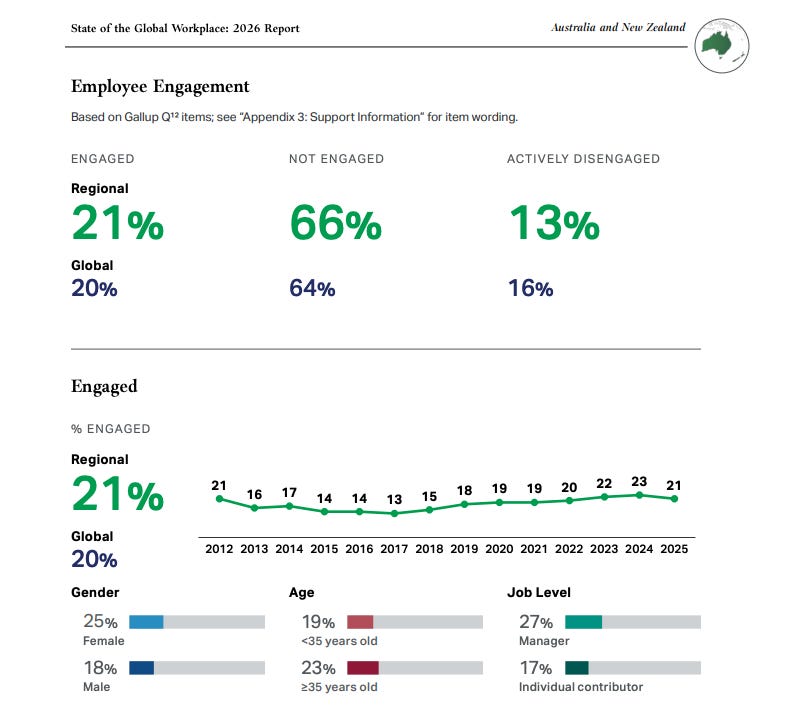
Let’s start with the outcome that shows the starkest differences between the three regions. The US/Canada reigns supreme, outperforming AUS/NZ, which hovers around the global average, and Europe, which sits below it. While some changes over time can be noted for Europe and the US/Canada, the trend line has been pretty flat for the past few decades. Australia has been stable for the past 5 years. The introduction of the report points out that the global decline in engagement is driven by worsening leader engagement. Although the report doesn’t detail the insights for leaders vs workers on region by region, the decline seems to be less of a problem for our regions of interest (Aus/NZ). For example, Europe’s engagement is so low that there is not a lot of room left to decline. Whereas In Aus/NZ, manager wellbeing is actually much higher compared to staff wellbeing (27% vs 17%) so even if it does decline for the next few years, leaders will likely continue to have higher engagement scores for a while compared to staff.
Job climate
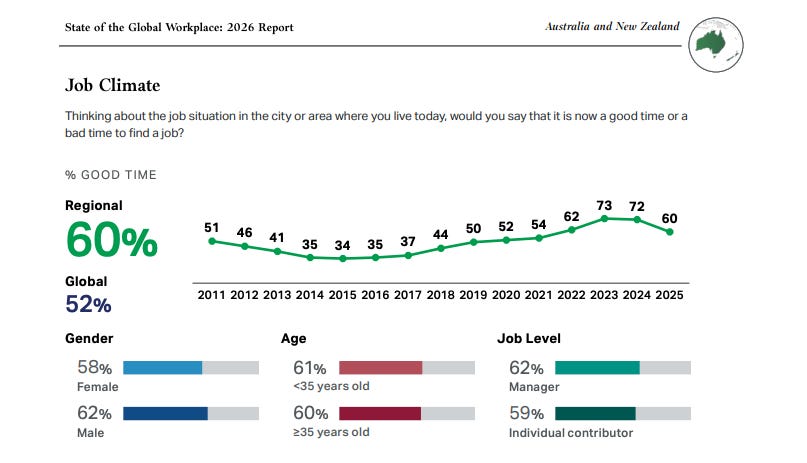
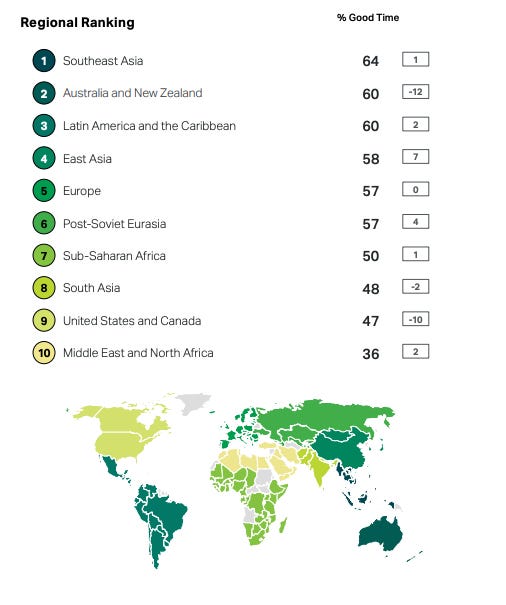
AUS/NZ has the highest job market optimism (job climate) compared to US/Canada and Europe, ranking at number 2 globally. Although this ranking looks optimistic, when we compare the ranking to last year, Aus/NZ has actually shown the biggest 1-year fall, with a steep 12-point drop.
This is a clear warning signal, which hopefully doesn’t flag a similar pattern to the US/Caanda region, which has been declining for a while now. Their 2026 ranking sitting below global average. Europe, on the other hand, continues to follow it’s own path, showing a reversed pattern. From an abysmal 17% in 2011, it has grown to 57% in 2026, sitting higher than the global average for the first time.
Life satisfaction
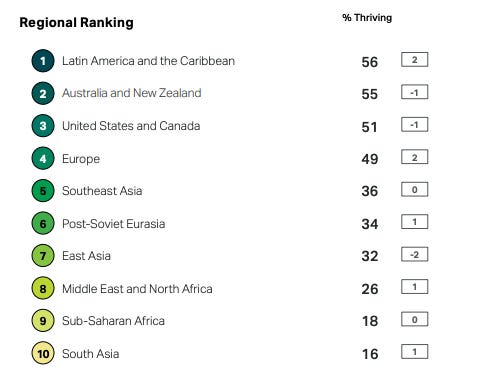
Life satisfaction for Europeans has remained fairly flat over time, but AUS/NZ and the US/Canada have been falling, with the latter showing a decline since 2019, and the former having a more gradual long-term decline. Having a high global position is one thing, but having your wellbeing decline year after year is another – one that should worry people in those regions, as it goes against the global trend.
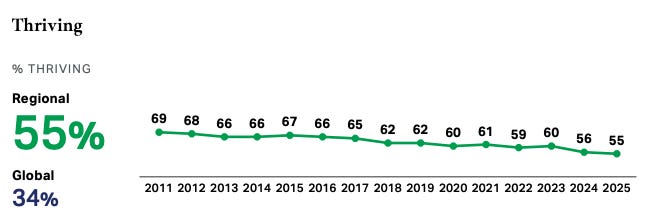
This mirrors what we saw in last month’s Global Happiness Report, which also flagged declining life satisfaction in Aus/NZ against more stable rates across much of Europe. That’s not a coincidence – the working population surveyed in the Gallup report is essentially a subset of the World Happiness Report sample. They’re drawing from the same data, just looking at different cohorts and trying to answer slightly different questions.
Stress
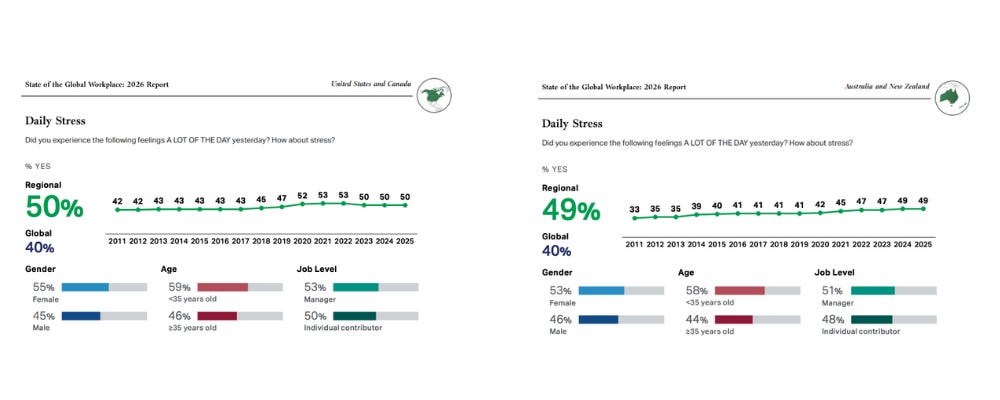
Workers in Aus/NZ and US/Canada show high stress levels, with roughly 50% indicating it bothers them. Europe tracks closer to the global average, not showing too much fluctuation over time. The increase for Aus/NZ is the most challenging, as it has risen 16% since 2011. Their stress trajectory is the steepest of the three, and although it started lower than the US, it has already risen faster and is now nearly level with it.
The main takeaways
- When reading reports like this, don’t stop at yearly averages or single-point comparisons between countries – those make for snazzy headlines but often miss the more important story. Ranking highly is one thing; a year-on-year decline is another. Always ask: who’s actually trending in the right direction?
- Strong results in one area don’t tell the whole story. Australia and New Zealand are a good example, ranking highly on life satisfaction while simultaneously struggling with some of the highest stress levels globally, and trending in opposite directions on each.
As always, we’ll leave you with one question to sit with:
What was the most surprising data insight you found in this article and why?
If you enjoyed this post, you can find this type of content posted regularly on our Substack. Including free insightful posts like this, and a members only section for professionals wanting to take insight to action.
Want to Read More?
 Workplace
Are Australian workplaces ready to support someone who is struggling?
October is both Mental Health Month and National Safe Work Month in Australia, and to mark the start of it our CEO, Dr Joep van Agteren, recorded a short video with a fairly sobering…
08 Oct 2026 3 min read
 Workplace
What is Protect, Promote, Respond?
What is Protect, Promote, Respond? If you’ve been working on mental health in your workplace lately, there’s a good chance you’ve come across the phrase Protect, Promote, Respond. It’s a way of describing the…
08 Oct 2026 6 minute read
 News
News
Introducing Wellbeing Explained
Today we’re launching Wellbeing Explained, a digital home where we invite experts to answer the questions others won’t, bust myths, and go deeper into the wellbeing science. Be Well Co sits in a unique…
04 Sep 2026