

Languishing: What it is and why it matters
1 in 5 employees are languishing. It's time we took notice, and took action
What is Languishing?
Have you ever felt like you’re moving through the day on autopilot, with low motivation, fuzzy focus, and joy just out of reach? That experience is known as languishing. Languishing is a state of low mental wellbeing marked by feelings of emptiness, stagnation, and disconnection. You’re not necessarily burnt out or clinically unwell, but you’re not feeling energised, engaged, or fulfilled either.
Many people describe it as feeling “stuck in a rut” or “not quite right”.

1 in 5 Australians are languishing
Our national study conducted found that 20% of people are languishing. Not mentally ill, but not feeling good or functioning well. This finding highlights something important: Languishing is a common experience. It represents a substantial portion of the population quietly struggling with low wellbeing.
Many of these individuals continue to work, meet responsibilities, and appear “fine”, while feeling flat, disengaged, or stuck beneath the surface. This means millions of Australians may be moving through work and life without feeling energised, motivated, or fulfilled.

The employee experience
Meet Geoff: he's showing up but he’s not really there. In this short video, we follow an employee who’s going through the motions at work, feeling flat, disconnected, and drained. Sound familiar? You’re not alone. This story captures what it looks like to languish in the workplace and what happens when you decide to make a change. If you've ever felt ‘meh’ for a little too long, this one’s for you.

The manager’s view
Something’s changed in the team and Natalie can feel it. In this video, we hear from a manager who notices her people withdrawing, slowing down, and losing steam. She’s not sure what to call it at first, but she knows something’s off. This video is for every leader who’s seen the signs of languishing and wondered: what can I actually do about it?

Why it matters to leaders
Impact on culture, retention and performance
Presenteeism is costing businesses
Employees are showing up but checked out, hurting productivity, creativity, and morale.
Languishing goes unseen
It’s not burnout, it’s not illness, but it’s quietly eroding performance, motivation, and connection in your teams every day.
Prevention starts with leadership
Languishing thrives in silence. Leaders who act early can prevent burnout, boost engagement, and rebuild resilient teams.
Support is falling short
76% of employees felt unsupported while languishing, your people are struggling silently, and most won’t speak up unless you do.How to recognise languishing in your team
Your team might be showing up, but are they switched on? Languishing looks like low energy, flat motivation, and people just going through the motions. It’s not burnout, and it’s not a mental illness. It’s that “meh” feeling that drags on morale and quietly kills momentum.
In our latest survey, employees described it as “feeling stuck,” “disconnected,” “exhausted,” and “like the joy has gone.” They weren’t taking sick leave: they were present, but mentally checked out. That’s presenteeism, and it’s costing your business more than you think.
Knowing the signs means you can step in early: before low energy becomes full disengagement.

Languishing at work workshop
Recharge your team's drive
If your team is feeling flat, unmotivated or simply going through the motions, they’re not alone. Many employees today are emotionally disconnected, low on energy, and struggling to find purpose in their work. Naming it for what it is is just the beginning.
Our dedicated workshop to languishing not only gives your people the language to name what they’re experiencing, but the tools to move through it. Through guided reflection, practical strategies, and actionable takeaways, we help teams reconnect to meaning, recharge their energy, and take real steps toward feeling and functioning better. Available as a 60- or 120-minute session, this workshop can be tailored to your team’s needs.

The ripple effect of languishing in the workplace
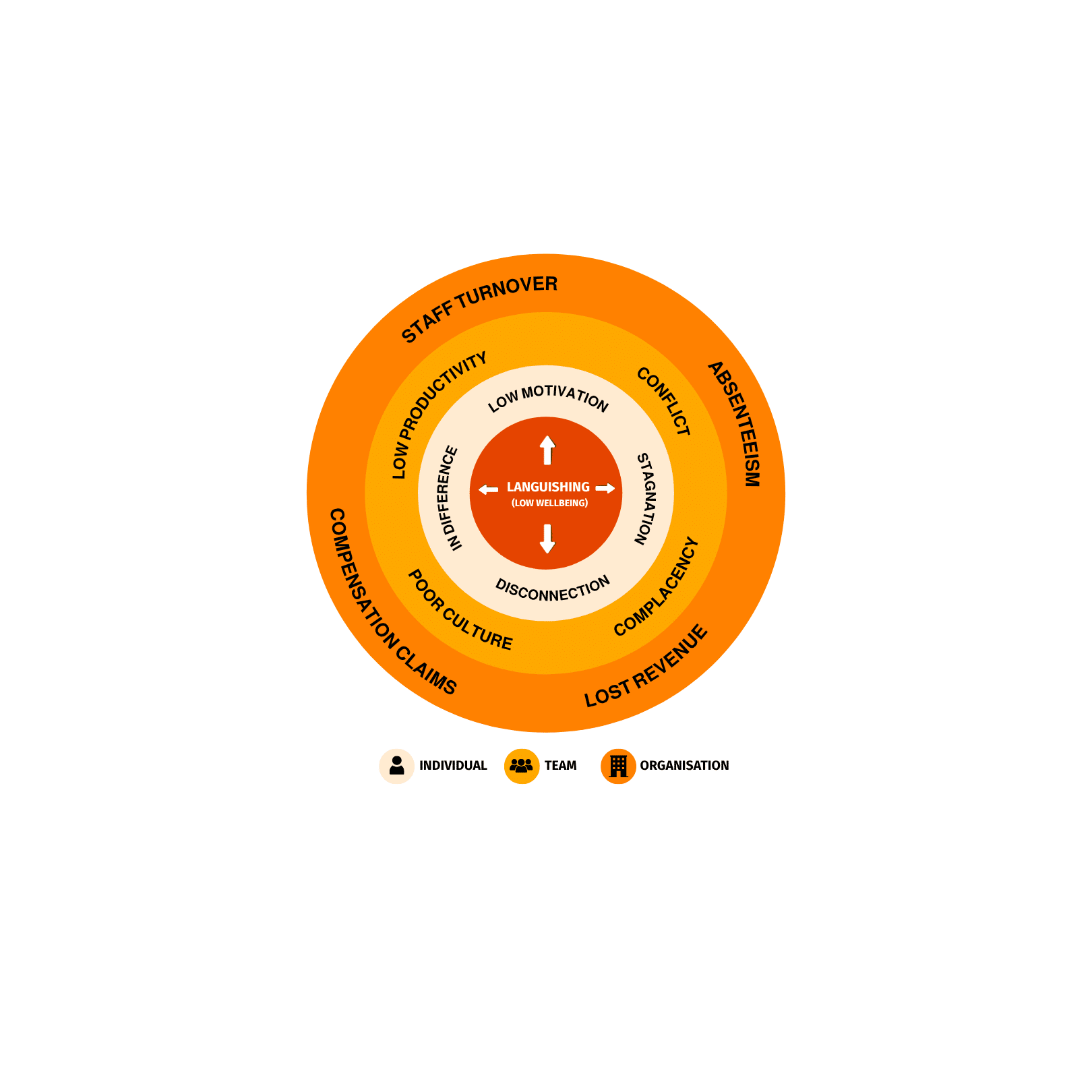
Languishing doesn’t stay contained. It starts with the individual – low energy, low motivation, low engagement – but it quickly ripples outwards. Teams become less collaborative, creative, and connected. Over time, performance, culture, and business outcomes take a hit. This visual shows just how far the impact of languishing can reach. It will effect: the individual or staff member (tier 1), teams (tier 2) & organisational outcomes (tier 3).
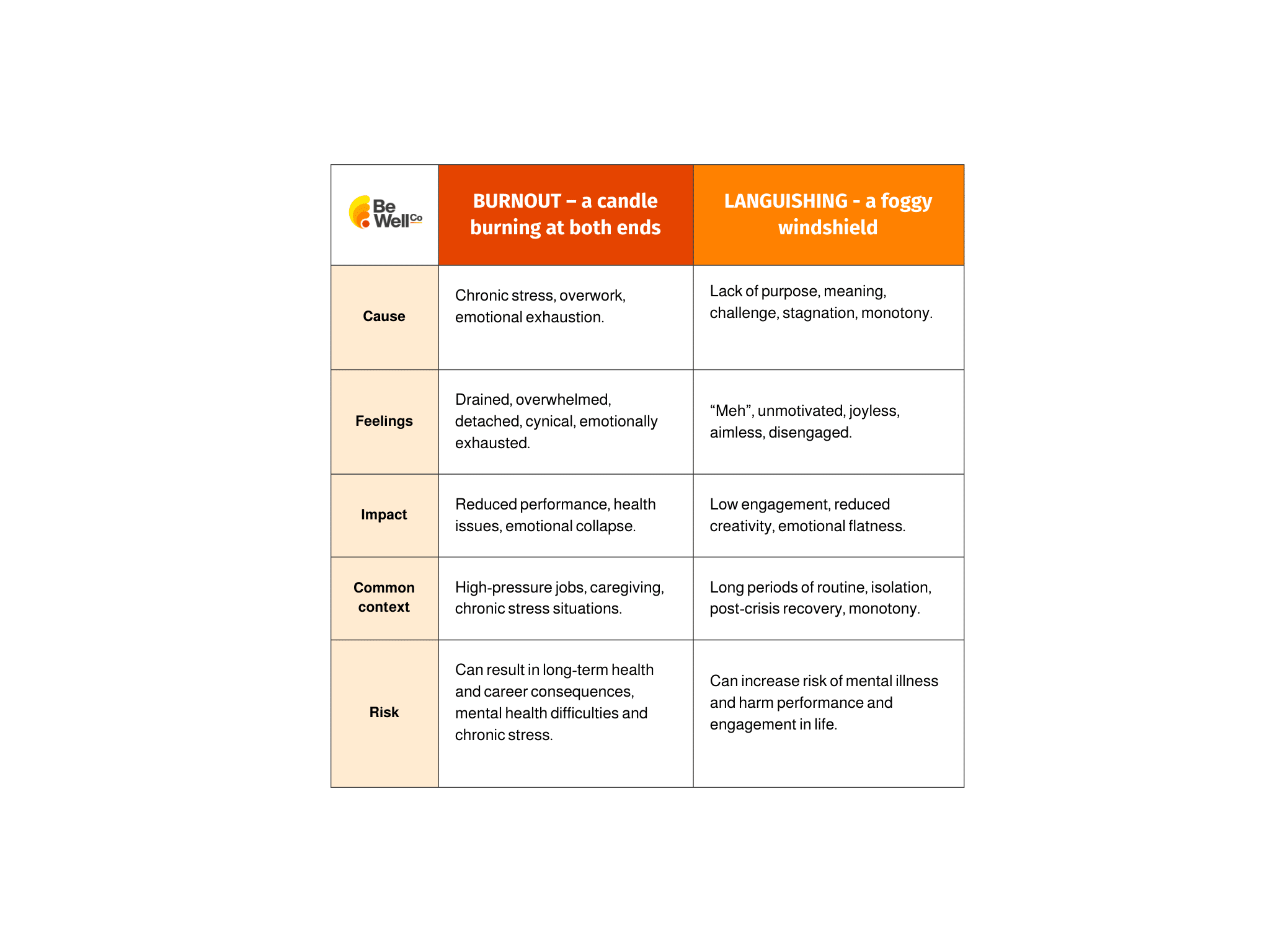
What if it isn't burnout?
We are too often saying that people are burned out, while they technically aren’t. Burnout is a state of exhaustion caused by prolonged stress. Languishing isn’t technically caused by prolonged exposure to stressors. This means that both diagnosis the problem and tackling it requires a different approach, as the figure beside explains.
The face of languishing
The Face of Languishing brings the invisible struggle of languishing to light through shared stories: people who didn’t have the words for what they were feeling, who didn’t know how to make a change, but found their own way forward.
Real human experiences that show different people going through the same thing, in their own unique way. Real humans who were surprised to hear about the stats. Real humans who had to find their own ways to deal with feeling not quite right, as they didn’t know how to make a positive change.
Thomas's Story
Thomas shares how COVID lockdowns during his senior years of school left him feeling stuck and lost, long after they ended. After a year of standing still in a state of Languishing, he decided to kickstart his life and began running his 5K daily, and kickstarted a new chapter of creativity and momentum in his life. Watch Thomas's story.

Tara's Story
During experiencing new motherhood, Tara found herself Languishing. She shares the painful gap between expectation of joy and her feelings of inadequacy and isolation. By prioritising her mental wellbeing, she rediscovered her spark. Her message to new mums: self-care isn’t a luxury—it’s essential. Watch Tara's story.

Luke's Story
Luke shares how success on the outside can mask an emptiness within, appearances are not always as they seem. After learning his experience of Languishing was not an isolated case, he felt inspired and reconnected with his passions, finding true purpose and meaning in his life. Watch Luke's story.

Enza's Story
After being made redundant and unable to get work, Enza was confined to her role as carer for her husband and ill son, leaving her to begin Languishing. She struggled with feelings of stagnation and losing her purpose in the face of home life pressures. Her turning point was reaching out and connecting with a friend to share she was not feeling quite right and in doing so, felt lighter. Watch Enza's story.

Joanne's Story
Joanne shares her experience with Languishing, how feeling lost and disconnected as a Uni student ultimately led her to rediscover her passions. A simple conversation sparked a life-changing moment, teaching her the power of reaching out and reconnecting with what she loves. CTA: Watch Joanne's story.

Frequently asked questions
What is Languishing?
Languishing is a state where an individual is dissatisfied with where their life is at the moment, or where their life is headed. They don’t feel good and they struggle to function as well as they could.
Their life starts to feel indifferent. They may feel stuck or stagnant, lack a clear purpose, motivation, and emotional engagement. People who are Languishing may feel aimless, experiencing a sense of stagnation without the acute symptoms of mental illness. A word that summarises it is 'meh' or 'blah'.
It is often described as the "neglected middle child" of mental health, failing to receive attention as we focus on mental illness on the one hand and striving for wellbeing on the other, failing to realise how bad it is when you don’t have either of these states.
A lot of the symptoms sound like depression. How is Languishing different?
Depression is marked by persistent sadness, hopelessness, and a significant impact on daily functioning. If you are depressed you lose interest in all or most aspects of life. You are depressed when you meet certain criteria that have to include persistent sadness and a lack of joy or pleasure in most parts of life, together with some things like feelings of worthlessness, suicide ideation, trouble concentrating or irritability (among others).
When you are Languishing you are experiencing a feeling of dissatisfaction with where you and life are at and headed. You feel emotionally stagnated and may not feel much positive forward-directed energy, or feel less interested in connecting with others. languishing is more about a sense of indifference, a lack of joy, purpose and optimism rather than overt sadness or thinking that life isn’t worthwhile. You struggle in some areas of life, rather than the struggle making everything in life seem pointless. Read more about Languishing vs depression here.
They share some common features but much of what defines them is separate, much like how stress and anxiety relate to one another. The symptoms of Languishing can happen together with symptoms of depression, but can also happen independent of one another.
What causes Languishing?
Languishing can be caused by a variety of factors. Some of these lie within ourselves, some are external to ourselves, and have to do with our relationships or our environment.
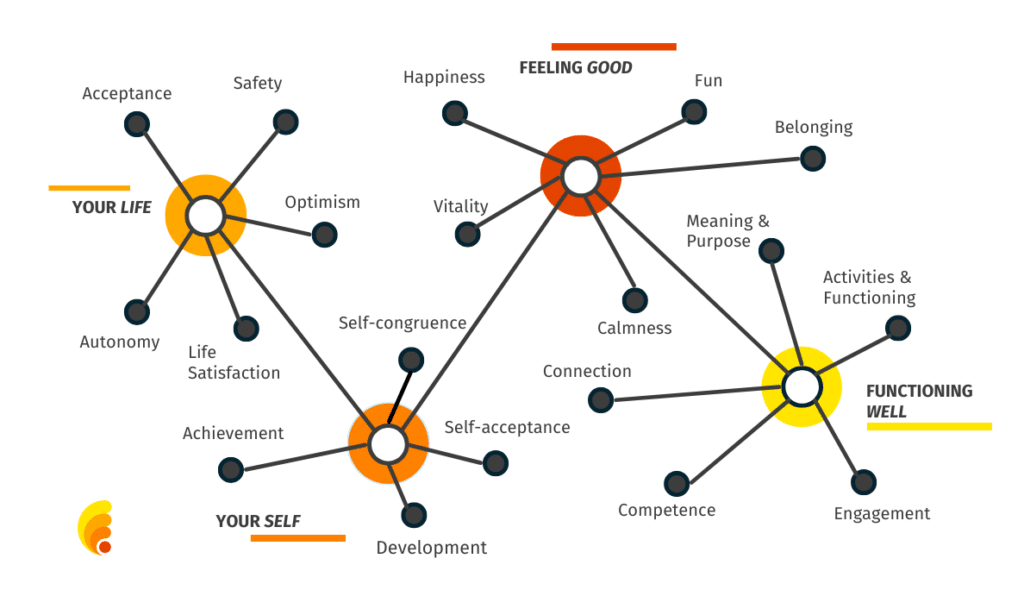
Our team has identified 19 empirically validated drivers of wellbeing. Each of these can boost our wellbeing or can be causing challenges, alone or in combination with others. When we looked at the big ticket items that seem to differentiate languishers versus flourishers, they were three major things we saw:
- Poor social wellbeing: Languishers do not feel part of a community; the lack belonging
- Poor purpose: Languishers lack direction in life and find less meaning in the activities they do
- Poor development: Languishers are stagnant, not feel they can grow or develop themselves as a person.
But there is much more that can drive a sense of Languishing. Check out the image below to get a sense of them.
Is Languishing a recognised psychological diagnosis?
Languishing is not a formal psychological diagnosis and it shouldn't be either. It is not a pathology or illness, but rather a problem with your wellbeing. While it makes people struggle significantly, this lack of a clinical acceptance is contributing to why many of us haven't heard of it. Although increasingly being recognised as problem we need to tackle, it has failed to be focused on the wider system. As such, it is often referred to as the 'neglected middle child of mental health' between our attempts to get people to flourish and our attempts at preventing and treating mental illness.
Is Languishing just made up pop psychology?
Languishing is not merely a pop psychology term. It is a concept that has been studied for decades across the globe under the guise of 'poor mental wellbeing'. A rigorous body of hundreds of studies has helped define the concept, develop measurement methods to assess the impact of poor wellbeing and study interventions to help alleviate it. A lot of research has focused on looking at the relationship of poor wellbeing with mental illness, with studies generally concluded both can co-occur but them being different form one another.
Why haven't we targeted Languishing before?
The science of wellbeing has gained a lot of momentum the last decades. A lot of new findings have come out with many people in the mental health space now looking to see how they can work with this new way of thinking. Change is slow, but most major NGO's and government departments in Australia are (or should be) aware of the importance of targeting Languishing. Wellbeing is increasingly considered in policy reports and practice. By giving it a formal name - Languishing - rather than just referring to it as poor wellbeing, we aim to speed up adoption. We launched our report and our campaign that sits around it to help stakeholders push for their own positive change. We are looking forward to working with those organisations who are looking to strengthen our collective focus on Languishing.
For the Languishing Report: Where did we source the participants from? Is the research peer reviewed?
The report is based on data our researchers and collaborators have been steadily collecting for the last 5 years as part of an ongoing scientific study. The research is not peer reviewed. We decided to publish it as a report rather than a scientific manuscript to speed up dissemination. Supporting information on the data can be found on an Open Science Framework (OSF) register.
Are there any particular cohorts or states that are more affected by Languishing?
Our data shows that it does not discriminate and affects people across the board. That said, there are certain cohorts that may be at more risk. The biggest demographic influence is age: Younger adult generally have worse wellbeing compared to older adults. People who are facing big stressful transitions or changes in life ( (like job loss, relocation or financial stress), may also be more affected by Languishing. This is because these changes or stressors affects the drivers of wellbeing, such as a sense of purpose, connection, personal circumstances, autonomy, connection etc.
How does Languishing look different in different age groups, and how?
We often think wellbeing operates according to a U curve, where wellbeing is high when we are children, dips during mid life, and then increases later on. Research - including our own - shows that this idea is not correct anymore. There has been a steady drop in wellbeing during younger ages, which has meant that the data now shows that young adults and the sandwich generation (those caring for kids and aging grandparents) struggle more, compared to 55+ adults.
What are the solutions for Languishing?
There is a lot of good research on this, which we have summarised in the report we did for Beyond Blue on 'what works to improve mental wellbeing'. Essentially, anything that boosts mental wellbeing can be used to alleviate Languishing. If you want to improve Languishing, you need to target the drivers that are causing the Languishing in the first place. This will differ from person to person, and depending on the need, the following 'interventions' or activities can be considered:
- Social prescribing
- Physical activity
- Nutrition and diet
- Art
- Acceptance and commitment therapy (ACT)
- Cognitive therapy (CT) and cognitive behavioural therapy (CBT) (if you struggle with symptoms of a mental illness)
- Compassion programs
- Expressive writing
- Forgiveness interventions
- Mindfulness
- Positive psychological interventions (PPIs) specifically when offered in programs rather than just standalone activities
- Reminiscence
- Yoga interventions
- Gardening interventions
- Nature-based interventions
- Social support interventions
If you are looking for something you can do yourself, without much expert guidance or the use of technology, consider picking up an activity that:
- Helps contribute to a sense of meaning (ie you do something that is important to you or gives you joy)
- Focuses on personal growth (ie you do something that allows you to pick up a new skill or strengthen an existing one)
- Include a focus on connections (ie includes a social element together with other people, particularly if you feel that your relations are lacking)
What are the implications for the future mental health of Languishing?
Prolonged Languishing can lead to a decline in overall mental health, increasing the risk of developing more severe mental health issues such as depression and anxiety (estimates range between 2x to 8x). On the flip side, if you reduce Languishing, you decrease the risk of a mental health problem, or if you are already struggling with depression or anxiety, can speed up your recovery.
How does Languishing affect the workplace?
People can Languish in their personal lives, in their professional lives, in both or neither. If someone is Languishing, it can result in decreased productivity, motivation, and engagement among employees. Individuals may feel disconnected from their work, leading to lower job satisfaction and increased absenteeism.
Ultimately it can fuel burnout: burnout is a state of exhaustion due to prolonged stress or challenges. You can be Languishing at work without experiencing prolonged stress or exhaustion although they tend to correlate. In other words: Languishing is not the same as burn out, but they amplify each other's risk.Languishing can also affect team dynamics, as employees who are Languishing may struggle to collaborate effectively or contribute positively to the work environment.
Organisations that recognise and address languishing can foster a more supportive atmosphere, ultimately enhancing employee mental health and productivity.
How does Languishing show up at work beyond general productivity loss? (e.g., specific behaviours, disengagement patterns)
Languishing at work can manifest through specific behaviours and disengagement patterns, including:
- Low Motivation: Employees may struggle to find meaning or enthusiasm in their tasks.
- Disconnection: Individuals might withdraw from team interactions, contributing minimally during meetings or avoiding collaboration.
- Reduced Initiative: Languishing employees are less likely to volunteer for new projects or bring fresh ideas.
- Indifference to Outcomes: A "just getting by" attitude, where quality and deadlines become secondary.
- Absenteeism and Presenteeism: Increased sick days or physically showing up while mentally checked out.
What are early warning signs that a team or company culture is struggling with Languishing?
Early warning signs of a culture struggling with Languishing include changes in behaviour for a longer period of time (2 weeks or more) in for example:
- Low Engagement: Consistently low participation in meetings and team initiatives.
- Increased Turnover: Employees leaving for unclear reasons or citing a lack of purpose.
- Communication Drop-Off: Minimal interaction or a shift towards only transactional communication.
- Diminished Collaboration: Teams working in silos rather than engaging in healthy collaboration.
- Negative Work Environment: A noticeable drop in morale, with more conflicts or a pervasive "meh" attitude.
What can leaders and HR teams do to support employees who are Languishing?
Leaders and HR teams can play a critical role in supporting employees who are Languishing by adopting a holistic approach that integrates a focus on individuals, relationships and the wider organisation. The Protect, Respond, Promote framework is a practical model to guide these efforts:
Protect: Conduct education and hazard assessments to identify psychosocial risks to mental health.
Respond: Provide tangible support for mental illness through Employee Assistance Programs (EAPs) and mental health services. Encourage open conversations about mental health, reducing stigma and fostering a culture of care.
Promote: Invest in proactive wellbeing initiatives, such as wellbeing strategies, education programs, and workshops.
Additionally, leaders and HR teams should recognise that Languishing is influenced by both workplace and personal factors. Effective support involves offering resources that help employees manage their personal mental health as well, such as wellbeing plans or programs that build resilience and purpose. By combining organisational strategies with individual support, workplaces can address Languishing early, prevent it from escalating into other problems such as burnout or mental health problems.
Who is responsible for tackling Languishing—leaders, HR, or employees themselves?
Addressing Languishing is a shared responsibility, with workplaces playing a critical role as the primary driver of support.
- Workplaces' Responsibility: Organisations need to create environments where Languishing is recognised, named, and openly discussed. By educating employees about what Languishing is and how it may show up in their work and personal lives, workplaces can help individuals identify and understand this state of mind. Workplaces should also provide practical tools and resources to empower individuals to make positive changes.
- Individuals' Role: Once people have the language to identify Languishing, they can better assess their own mental health. With the right support and resources (that they find themselves or for example get from their workplace) individuals can take proactive steps to improve their wellbeing. Languishing, just like wellbeing, is a do-word: individuals will need to take steps themselves if they want to start feeling better.
- Leaders and HR Teams: Leaders and HR play a pivotal role in bridging the gap. They can champion wellbeing initiatives, model healthy behaviours, and foster a culture where mental health conversations are normalised .
By combining organisational support with individual action, workplaces can effectively tackle languishing, enhancing both employee wellbeing and overall organisational health.
Can Be Well Co help me with Languishing?
While we are developing a publicly available community on Languishing, Be Well Co mainly works with organisations who want to help their staff thrive. Our evidence-based programs are specifically designed to target Languishing and we work with a wide range of organisations and government departments to help their staff address both Languishing, and develop skills to manage their mental health in general. Our focus is all about giving people the skills to build resilience and wellbeing before problems arise, offering practical tools to empower individuals to make a positive change if they are up for it.