

What does it mean to be well? Landmark research delivers building blocks for good mental health
13 Apr 2026 • 3 minBe Well Co and Adelaide Unviersity landamrk study published in Nature Mental Health
For decades, ‘mental wellbeing’ has been one of the most used, but least agreed upon, terms in mental health. Now, a landmark study led by Adelaide University and Be Well Co has brought alignment to one of mental health’s most fundamental questions – what does it actually mean to be well?
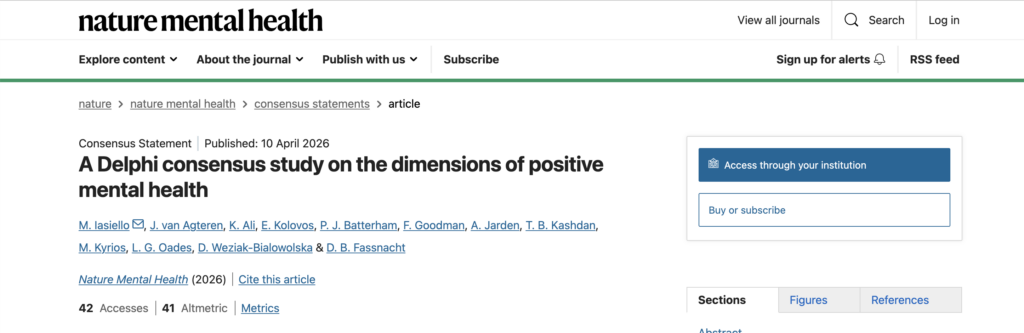
Conducted in partnership with Australian and international academics, and published in Nature Mental Health today, the study is the first to achieve international consensus on what constitutes positive mental health and what does not.
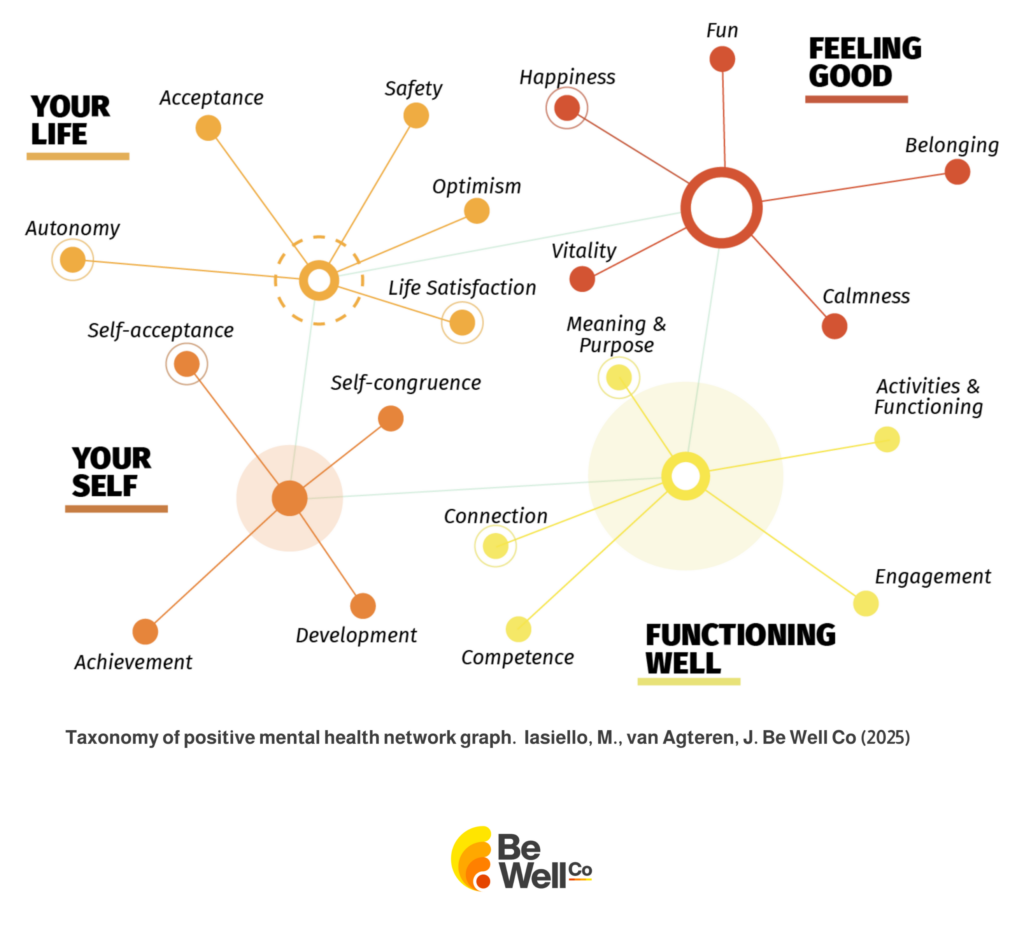
Surveying 122 global experts across 11 disciplines, researchers achieved agreement (75%+ consensus) on 19 dimensions, with near‑unanimous agreement (90%+ consensus) on six factors that are essential to positive mental health:
- Meaning and purpose – feeling life is worthwhile and goal‑directed
- Life satisfaction – overall evaluation that your life is good
- Self‑acceptance – positive and non‑judgemental view of self
- Connection – close, caring relationships with others
- Autonomy – feeling in control of choices and self‑expression
- Happiness – frequent positive mood and cheerfulness.
The definition is designed to inform how mental wellbeing is measured, supported and promoted across healthcare, workplaces and public policy.
“By agreeing that positive mental health isn’t a single feeling, but a combination of how we feel, how we function and how we connect with others, the study brings much‑needed clarity to the field,” said Adelaide University researcher Dr Matthew Iasiello.
“For too long, mental wellbeing has been defined in different ways across research, healthcare and government, making it almost impossible to compare evidence or design effective policy.
“Imagine if there were 150 different ways of measuring blood pressure – the results would be meaningless. That’s why it’s important to agree on what positive mental health is, and what it isn’t.”
Factors such as physical health, income, housing, coping strategies and spirituality were determined not to define positive mental health, instead being considered important drivers of it.
Importantly, the study confirms that positive mental health is separate from mental illness, meaning people can experience mental wellbeing even while living with a mental health condition.
Across 11 disciplines (Economics, Medicine, Nursing, Philosophy, Psychiatry, Clinical Psychology, Health Psychology, Positive Psychology, Public Health, Sociology and Theology), researchers confirmed a total of 19 dimensions of mental wellbeing*, including the six dominant factors.
“Positive mental health isn’t about feeling good all the time,” Dr Matthew Iasiello said.
“It’s about having a combination of emotional wellbeing, psychological functioning, and social connection that helps you live a meaningful, manageable life, even when things might be hard.
“In this way, positive mental health is less about feeling good all the time, and more about having the right combination of factors to cope, live well, and experience life as meaningful.
“When people can better recognise which parts of their wellbeing are strong, and which might need support it gives them a clearer sense of where to focus their efforts.”
Co-researcher, Adelaide University and Be Well Co’s Dr Joep van Agteren said the research is not only about advancing scientific understanding, but essential to guide mental health policy, programs and measurement tools.
“Workplaces, government organisations and community groups often need help to build the conditions that help their people to thrive,” Dr van Agteren said.
“Understanding what makes up positive mental wellbeing helps individuals and organisations focus on what can really makes a difference.
“Whether it’s government departments creating spaces for connection, or teachers building optimism in kids at school, many of us are already contributing to wellbeing without realising it.
“We hope that this taxonomy can further strengthen the efforts of anyone who is trying to do their part in making people feel their best, in Australia and beyond, is worthwhile.”
The findings underscore the importance of a shared definition for guiding research, policy and practice going forward.
“You can’t build what you can’t define,” said senior author and Associate Professor Dan Fassnacht, University of the Sunshine Coast.
“For the first time, we have a scientifically agreed blueprint for what good mental health actually looks like – and that changes everything.”
Notes
- *The 19 Dimensions of Positive Mental Health include: Acceptance · Autonomy · Safety · Happiness · Fun · Optimism · Life Satisfaction · Vitality · Belonging · Calmness · Meaning and Purpose · Self-Acceptance · Self-Congruence · Achievement · Development · Connection · Competence · Activities and Functioning · Engagement
- The study team included: Prof Lindsay Oades (University of York Mumbai), Assoc Prof Aaron Jarden (Edith Cowan University), Prof Philip Batterham (Australian National University), Assoc Prof Dan Fassnacht and Dr Kathina Ali (University of the Sunshine Coast), Prof Emeritus Mike Kyrios and Ms Elli Kolovos (Flinders University), Prof Todd Kashdan (George Mason University, USA), Assoc Prof Fallon Goodman (George Washington University, USA), and Assoc Prof Dorota Węziak-Białowolska (Harvard University and Kozminski University, Poland).
This press release was produced in collaboration with Adelaide University’s media team.
Want to Read More?
Research
What does it mean to be well? Landmark research delivers building blocks for good mental health
Be Well Co and Adelaide Unviersity landamrk study published in Nature Mental Health For decades, ‘mental wellbeing’ has been one of the most used, but least agreed upon, terms in mental health. Now, a… 13 Apr 2026 3 min read Wellbeing, Workplace
Why change at work feels so hard (and what to do about it)
Change is unavoidable. Most of us know that intellectually and yet, when it actually arrives, it rarely feels as straightforward as we expect. A new structure is announced, a role shifts, a strategy pivots…… 25 Mar 2026 4 min read
 Wellbeing
Do we need to rethink how we think about mental health?
We often treat mental health and mental illness as opposites. If you are not mentally ill, you must be mentally well. If you are struggling, wellbeing must be low. Research suggests it is not…
03 Mar 2026 3 min read