
What is Positive Mental Health really?
The Taxonomy of Positive Mental Health is a research-led framework that brings clarity to what positive mental health actually means.
Developed through large-scale validation research and international expert consensus, the taxonomy identifies the core dimensions that contribute to positive mental health and organises them into a shared, practical structure. It provides a common language for researchers, governments, workplaces, educators and communities to design programs, policies and initiatives that genuinely support people to thrive.
This work is a 3-part study. You can find study 1 here, study 2 here, or download the final report below.

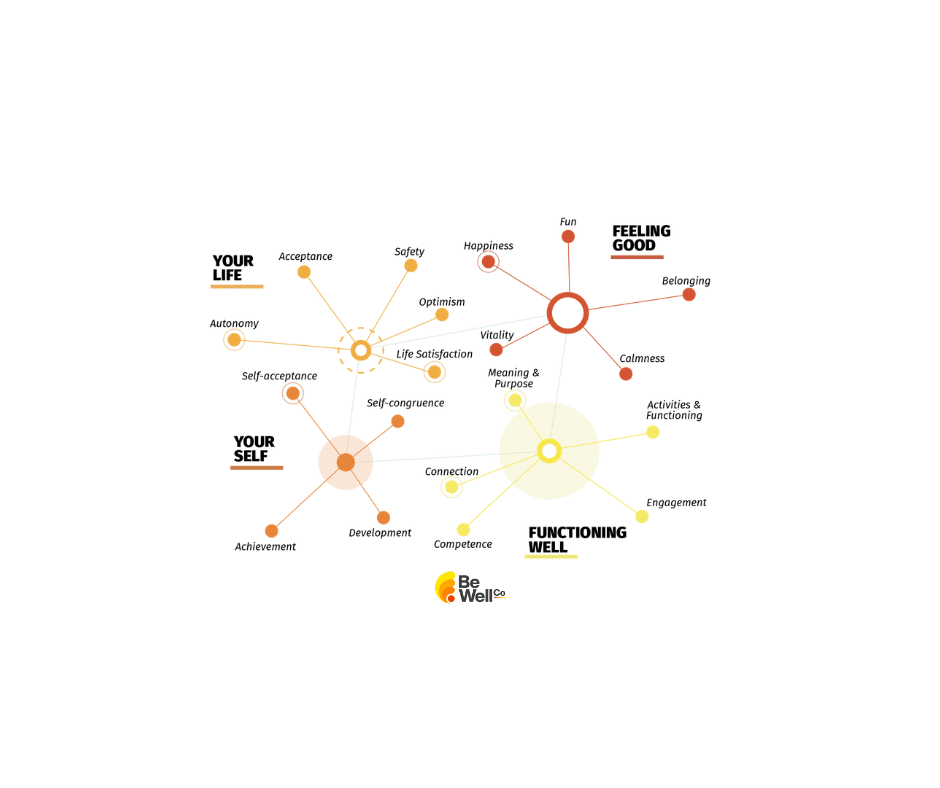
The four core pillars of positive mental health
Positive mental health is made up of four interconnected pillars, within which sit 19 distinct dimensions. These dimensions reflect the breadth of how people experience wellbeing: emotionally, psychologically, socially and functionally. Importantly, high scores across all dimensions are not required for positive mental health. The relevance and importance of each dimension vary from person to person.
Your Life
How individuals experience and evaluate their lives overall
ACCEPTANCE
The ability to self-reflect, identify what is within a person’s control, and accept what is outside one’s control.
AUTONOMY
The perception that we have ownership over our behaviour and choices, and the ability to express oneself.
LIFE SATISFACTION
The degree to which a person positively evaluates the overall quality of their life as a whole. In other words, how much the person likes the life they lead.
OPTIMISM
Having a positive outlook on life, and positive expectations about the future.
SAFETY
The feeling of relative security in one’s daily life.

Your self
How individuals view and relate to themselves
ACHIEVEMENT
Having done something successfully, using one’s own efforts and skills.
DEVELOPMENT
Experiencing growth and improvement.
SELF-ACCEPTANCE
Experiencing different aspects of oneself (e.g., one’s body, personality, thoughts, and feelings) in a positive, tolerant, receptive or non-judgmental way; experiencing positive self-worth.
SELF-CONGRUENCE
The perception that our actions and behaviors are compatible with our interests, values, and beliefs.

Feeling good
The quality of people's emotional experiences
BELONGING
The feeling of deep connection with social groups, physical places, and individual and collective experiences.
CALMNESS
States characterised by low-activation pleasant feelings, like serenity and peacefulness.
FUN
Experiencing light-hearted pleasure, enjoyment, or amusement; entertainment.
HAPPINESS
States that are characterised by moderate-activation pleasant feelings, such as feeling happy, cheerful and pleased.
VITALITY
States characterised by high-activation pleasant feelings, such as feeling energetic and lively.

Functioning well
How effectively people engage with life and the world around them
ACTIVITIES & FUNCTIONING
Overall satisfaction with our activities and leisure (i.e., the behaviours and activities that characterise daily life), and our ability to undertake these tasks.
COMPETENCE
Feeling and perceiving oneself as effective and able to overcome challenges and stressors, and achieve desired outcomes.
CONNECTION
Involving a feeling of mutual caring, love, and closeness to friends, family and loved ones.
ENGAGEMENT
Having an absorbing experience in which the individual is completely focused on the task at hand or experiencing a state of mindful awareness.
MEANING & PURPOSE
Having clear goals, a sense of direction and a larger aim in life and/or the feeling that what we do is worthwhile, rewarding and valuable.

A shared definition of positive mental health
Alongside the development of the taxonomy, this work contributed to establishing a shared definition of positive mental health, developed in partnership with Beyond Blue and agreed upon by international experts.
“Positive mental health is a personal and subjective experience, where we are content with our lives, feel good, function well, and view ourselves favourably. Our level of positive mental health can vary over time and is influenced by the way we adapt to the problems and opportunities we face. It is shaped by factors such as our environment, life experiences, cultural background, biology and behaviours. Importantly, positive mental health can be improved – even when a person is living with a mental health condition.”
This definition underpins Beyond Blue’s national evidence review on what works for mental wellbeing. Explore “what works for mental wellbeing” report here.
A rigorous, multi-stage research process
The taxonomy was developed through a series of complementary studies:
Comprehensive literature review
A review of published wellbeing measures identified 155 tools covering 420 dimensions, which were synthesised into a smaller set of unique dimensions.
Validation study
Item pools were tested with 800 participants across Australia and the United States, confirming that the dimensions were distinct and measurable.
International expert consensus
A global panel of 122 experts across 11 academic disciplines, representing 26 countries, participated in a structured consensus process to refine and agree on the final dimensions.
The framework
Through multiple rounds of review and voting, the group agreed on 19 core dimensions organised under four pillars.Why clarity matters
As interest in wellbeing has grown, so has confusion.
Decades of research produced: Inconsistent definitions of wellbeing, overlapping terminology and more than 150 different measurement tools claiming to assess over 400 aspects of wellbeing.
Without a shared framework, progress slowed. Findings were hard to compare, interventions difficult to design, and measurement inconsistent. To move the field forward, we needed to agree on what is — and what isn’t — positive mental health. A taxonomy offered a way to bring order, clarity and consistency to a fragmented landscape.
A framework for action, not prescription
The taxonomy is non-prescriptive by design
It offers a shared foundation, while leaving room for individual expression and agency. It recognises that: a) Positive mental health looks different for every individual b) People prioritise different dimensions at different times c)Wellbeing is shaped by context, culture and lived experience. Rather than telling people how to live well, the taxonomy supports:
- Reflection on personal values and priorities
- Intentional design of programs and policies
- Clearer measurement and evaluation of wellbeing initiatives
Informing long-term wellbeing strategy in Victoria
The Taxonomy of Positive Mental Health informed the Victorian Department of Health’s 10-Year Wellbeing Strategy, supporting a shift toward prevention and promotion of mental wellbeing at a population level. By clarifying what positive mental health includes, the taxonomy provided a foundation for designing coherent, evidence-based wellbeing initiatives across systems and settings.
